
It is easy to conclude that companies totally changed with the election of Donald Trump. I’m pleased to say that isn’t true though as Neil Hawkins and Kelly Cooper, writing last fall in the Harvard Business Review, showed late last year. Of course, some business leaders abandoned what were previously said to be deeply held commitments to fight climate change or promote fairer societies. It shouldn’t be a surprise that some people can be a bit cowardly, we’ve known that all along. More interestingly, but still not ideal, is the greater number of companies that continued doing what they were doing before but just shut up about it, i.e., they greenhushing. What do we know about such greenhushing by public and private companies.
Greenhushing And The Death Of Coalitions
One of the big problems with greenhushing is that it undermines the ability of companies to work together. Greenhushing is a coalition killer. If companies in an industry are able to come up with a common approach then they can often drive dramatic improvements. If no company wants to be seen to be doing anything it is hard to imagine how they can work together.
Greenhushing is not the same as abandoning the work. For many leaders, it’s a calculated choice to reduce political exposure, avoid activist backlash, or sidestep regulatory complexity.
Hawkins and Cooper, 2025
Greenhushing might seem to be okay — after all the company continues to do some work to solve the problems of the world — but secret works simply aren’t as effective as splashy works. You can’t lead others if you won’t let anyone know where you are going.
This gap between perception and reality matters because perception drives market behavior. Media coverage of retrenchment can normalize inaction, embolden laggards, and distort competitive benchmarks. It can also undermine investor and shareholder confidence in sustainability as a driver of long-term value, creating a false signal that the market is cooling when, in fact, many are increasing their efforts.
Hawkins and Cooper, 2025
Greenhushing: A Dominant Strategy
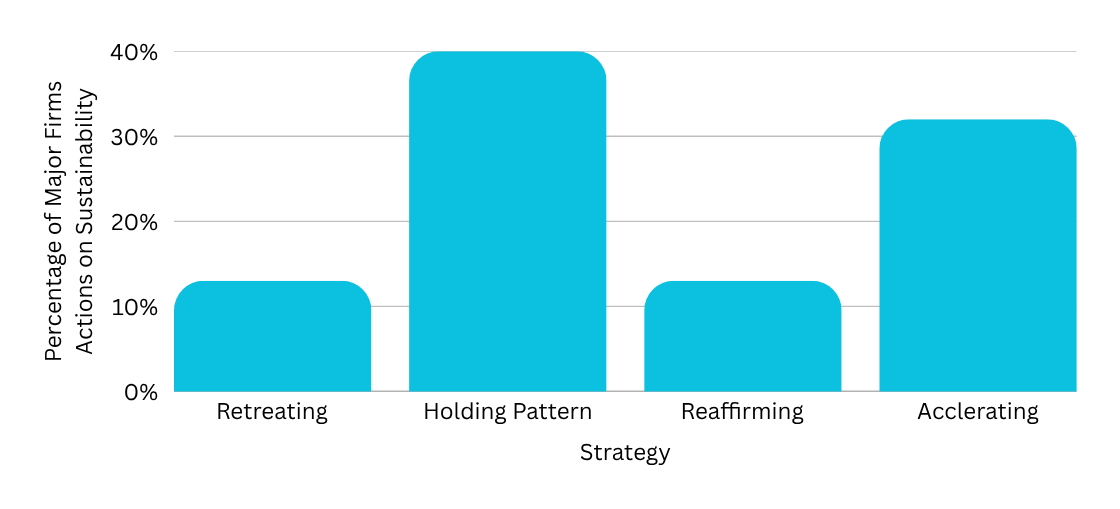
The analysis of what was happening to corporate sustainability commitments shared by Hawkins and Cooper is a mixed bag. Still, it is certainly much better than any who think that corporations have completed abandoned their efforts would guess.
While 13% of companies were Retreating from sustainability actions, the vast majority weren’t. 40% were in a Holding pattern, not changing plans but keeping quiet about them. A further 13% were Reaffirming their commitments, carrying on somewhat as before. Excitingly 32% were Accelerating their commitments, when others are hiding it is a great time to get ahead of the competition.
Greenhushing By Private And Public Companies
The authors considered which companies were most likely to go forward or bad. Thos who had sustainability embedded in their operations (rather than those relying on reputation benefits) or had experienced leadership were more likely to stay committed.
Private firms — without the need for quarterly reporting than impacts public firms — proved more resilient in their sustainability reporting. Donald Trump has announced plans to do away with quarterly reporting. You might instantly have thought the was defending the interests of his senior executive buddies who don’t want to be bothered by reporting to the little people who own shares. Maybe though Trump is committed to sustainability but just likes to keep his commitments quiet? That would be a plot twist worthy of any soap opera — and even less credible then when it was all a dream.
For more on greenhushing see Greenhushing Is A Big Problem, Hiding Their Good Works and A Broad Or A Narrow Church
Read: Neil Hawkins and Kelly Cooper (2025) “Are Companies Actually Scaling Back Their Climate Commitments?”, Harvard Business Review, https://hbr.org/2025/09/are-companies-actually-scaling-back-their-climate-commitments