
Tima Bansal and Valen Boyd have a new paper on business school challenges with teaching sustainability. It seems clear that business schools haven’t got it right yet so what do the authors have to say about sustainability, simple models, and business schools?
Teaching Sustainable Business
Business schools want to make a positive impact on society. Indeed, accreditation from bodies such as AACSB (Association to Advance Collegiate Schools of Business) often relies upon that.
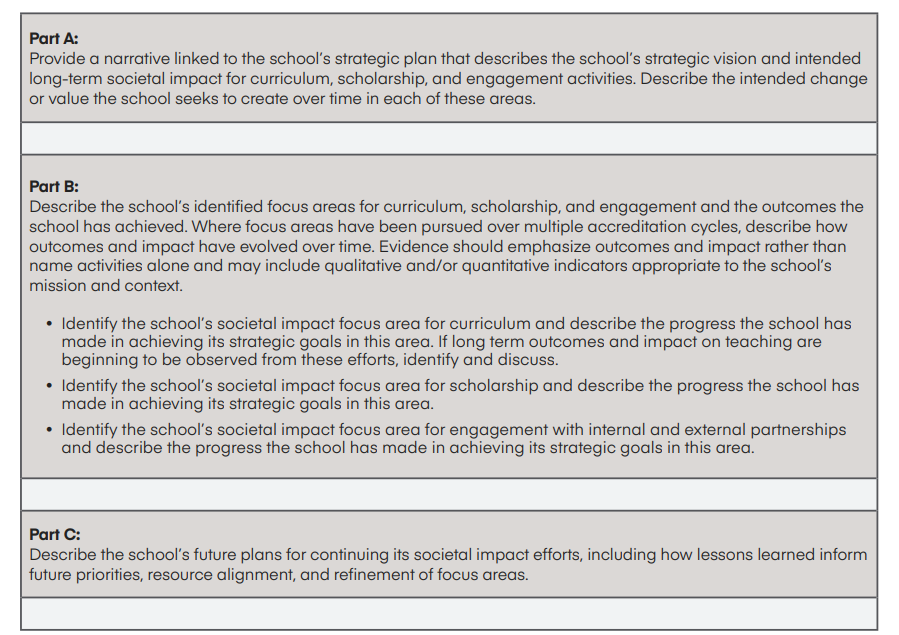
Table 9.1 From AACSB’s Accreditation Standards Which Focused On Societal Impact, see 2026-global-standards.pdf
Teaching (and researching) sustainable business can be challenging. This means despite good inentions there are a number of reasons why teaching sustainable business is thought to have had limited success. These include:
- Business schools focus on rankings which reward getting students high salary jobs.
- Adoption of neoliberal ideology.
- Academic incentive to publish research over engage with the world.
These make sense to a greater or lesser extent. (Although I am not a fan of the term neo-liberal, given definitions of what this means often seem weak).
The authors suggest another challenge. That business schools get into trouble with different unit of analysis. People get confused when translating ideas between the micro (individual level) and macro (systems level). Thus, things that might be true of market behavior are not true of individual behavior and vice versa.
Sustainability, Simple Models, And Business Schools
What resonated most was their comments about how we teach preferences.
Students learn to view self-interested behavior not as a simplified modeling assumption but as a prescription for how they should act.
Bansal and Boyd, 2026
I am convinced that economic uses the idea of self-interest not because of some deep philosophical belief but because math models are simply easier if you do. ‘What does person X want?’, is a relatively simple question compared to ‘what does person X want given their concerns for person Y who is in turn concerned about the wellbeing of person Z?’ In economic theory we would all be nicer people if the math were easier.
Delivering Change
Change is hard though. We teach future managers and big picture thinking about complex problems is harder to fit into a class than clear advice on where a debit and credit goes. Students like clear advice. Professors like giving clear advice. Clear advice is easier to use. Asking people to think about complex systems that are resistant to change can be a big of a dead end.
As a marketer I will put in a plea to see marketing as not just applied psychology as it appears in their figure. When I was at Ivey, where Tima — the lead author is — I am pretty sure I was assessed by administrators who thought I was a psychologist, I’m not and never was. Marketing isn’t just applied psych, indeed, sometimes our work doesn’t have any application at all.
For more on business schools Business School Academia And The Craft Guild, Thinking Differently About Business School Cases, Business Schools And The Teaching Of Political Marketing, Win-Wins Are Good For Stakeholders, and Academics Can Be Biased Too
Read: Bansal, Pratima, and Valen Boyd. (2026) “Why Sustainability-Related Education Does Not Stick in Business Schools—and How to Fix It.” Organization & Environment, 10860266261434783.